Why do job applications make you retype your resume after uploading it?
By Josue Reyes, UX researcher and founder of AppStride · Updated August 6, 2026
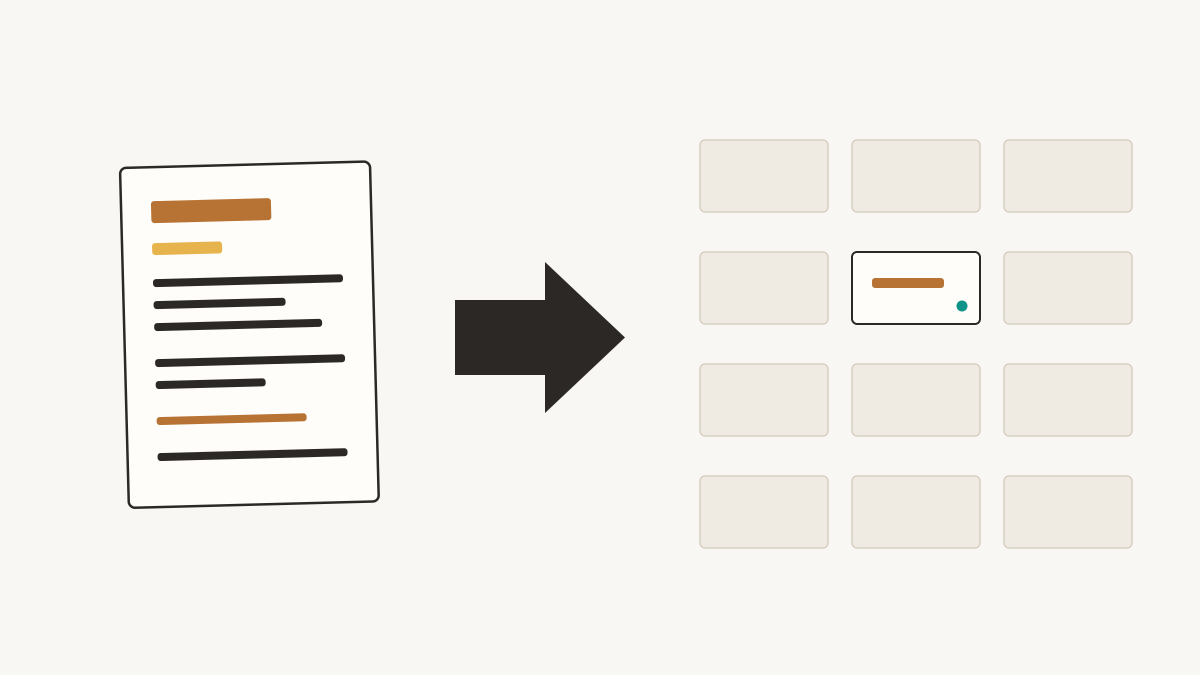
The short answer
Job applications make you retype your resume because employers don’t trust the parsing software that reads it, and because you aren’t the customer. Parsing fails often enough that companies make applicants do the data entry instead. The company bought its applicant tracking system to organize hiring, not to save your time, so your twenty minutes is the cheapest line item in the transaction.You know the moment. You upload a resume you spent hours on, the page spins, and the next screen presents your own work history back to you: half empty, wrongly dated, your job title sitting in the city field. Then it asks you to fix everything, box by box. This is what’s actually happening on the other side of that screen.
The parser read your resume. Badly.
When you upload, the applicant tracking system runs your file through a resume parser, software that tries to turn a designed document into database fields. Parsing is genuinely hard. A resume is a layout. It has columns, section headers, tables, dates floating on the right margin. When a parser flattens that layout into plain text, the reading order scrambles, and a two-column resume can interleave your skills list into the middle of your job history.
I can say this without pointing fingers, because I build one of these parsers. AppStride’s resume parser doesn’t handle multi-column layouts either, and we tell users so. The difference is what happens after the failure. A tool built for you shows you the miss and helps you fix it once. An ATS built for the employer hands you the blank boxes and walks away. It will hand you the same blank boxes next week, at the next company, and at the company after that.
Employers know the parsing is unreliable. That is precisely why the boxes exist: typed fields give the company clean, structured, filterable data, guaranteed. You re-keying it is the guarantee.
Seven pages is a choice someone made
The second thing hiding behind that screen: there is no such thing as “the Workday application.” Workday, Greenhouse, and the rest sell a toolkit, and each employer’s HR team assembles its own form from it. Working across these systems daily, I’ve seen tenants of the same platform ask for four fields (name, email, resume, done) and others that stretch the identical software across seven pages of employment history, references, and essay questions. When an application feels senselessly long, someone at that company chose that length. It is not a law of the software.
The cost of that choice is measured, publicly. Recruiting-data firm Appcast found that 92% of people who click Apply never finish the application, and in survey research reported by SHRM, 60% of job seekers said they had quit an application midway because of its length or complexity. Appcast’s data also shows completion roughly halving once a form passes fifty questions. Employers can read these numbers as well as anyone. The seven pages survive anyway, which tells you how much the applicant’s afternoon weighs in the decision.
You aren’t the customer
This is the part my UX research training won’t let me ignore. Enterprise software has a famous defect: the person who buys it is not the person who suffers it. The ATS’s customer is the talent acquisition department. The roadmap serves their reporting, their compliance, their workflow. The applicant is not a buyer, files no support tickets, and appears in no renewal negotiation. Your time is what economists call an externality, a cost the system produces that nobody inside the system pays.
The receipts are everywhere. Blind, the anonymous forum for tech workers, has years of threads with titles like “I hate filling Workday applications” and “Workday ATS has the most abysmal, disgusting resume parsing technology”. The complaints have not changed in a decade. Neither has the software. That tells you who the roadmap listens to.
Is the friction deliberate?
The popular theory says yes: the retyping is a motivation filter, designed to shake off anyone not serious about the role. People who work near these systems sometimes claim employers prefer it that way. Having watched how these forms actually get configured, I believe indifference explains far more than strategy. Most hiring teams never apply through their own portal, so they never feel the seven pages. For you, though, the effect is identical.
A wall built by neglect stops you exactly as well as a wall built on purpose.
What you can do about it
- Keep a master answers document. Every field you’ve ever been asked (salary expectations, start dates, references, the why-us paragraph) in one place you paste from. Never compose inside the form; forms time out and eat your work.
- Let software do the retyping. Autofill tools exist for exactly this pain, and no, the ATS cannot tell you used one. I build one: AppStride fills these forms from your resume and remembers the answers you correct. There are others. Whatever you use, the rule that matters is the next one.
- Review every field before you submit. An application usually can’t be edited after submission. The twenty seconds of review is the best-spent time in the whole process, no matter who, or what, did the typing.
The boxes aren’t going away soon. They will go away when the person who buys the software becomes the person who has to type into it. Until then, the only fix is to stop being the one doing the retyping.